Amperzen Logo

Add to Technorati Favorites

Event Calendar

Gumshoe Review Logo

SFRevu Robot Logo

TechRevu Ad

Darn…I’m getting a cold

Posted in Hearth and Home, Knitting, Socks on May 7th, 2009

Insomniac Sheep Art Poster Print by Rob ScottonI hate this — I’ve things to do and all that jazz and I think I’m coming down with a cold. Sore throat and a headache that won’t quit today. I read the same page at least 8 times and the only reason I caught myself was I kept starting to write a note and found I already had one written.

Now that makes for a wasted day. Finally I gave up and watched 50 First Dates — figured if my memory was going down the tubes I might as well watch a movie where someone had a worse memory than I did. I love the scene with the little penguin waiting on the road and she drives right over him…. Can’t imagine what the video would say while she was pregnant — can you?

I knit on my sock a bit today; just a few rows. Ended up pulling it out three times yesterday until I ended up with the right feel to it. It was just way too big the first time. If fit okay but didn’t look right and then I realize I had it on over my thick socks. So, ripped out about 4 inches and decreased and knit it back up. Then looked at it and it had this weird bump after the toe increased and before I decreased. So, out it came again — this time down into the toe increases stopping at the increase that gave me 64 stitches. I knew I’d done it wrong by not going all the way back but I thought I could live with it and I couldn’t. So, now I’m working on getting it up to the heel again. Then I have to decide if I want a short row heel, and after-thought heel, or an upside down heel. I’m thinking after-thought now but I’ve got about 2 inches to go to make up my mind.

Anyway, hoping to get back in step with some sort of schedule soon — yeah, real soon now. Doesn’t that sound like the check is in the mail talk? I’m sick of rain already but we’ve got a few more days of it to go.

Maryland Sheep & Wool…still good even in the rain

Posted in Fiber, Knitting, Maryland Sheep & Wool on May 5th, 2009

Maryland Sheep & Wool 2009It was a whirlwind weekend but on Sunday, Hyperion and I drove out to Howard County Fairgrounds in West Friendship, MD to the Maryland Sheep and Wool Festival. It’s always held on the first weekend in May. We’ve been going for years now. I love it and save my pennies up for a big splurge of wooly and fibery goodness each year.

This year it rained. We woke up early so we could get there at a decent time since everything shuts down at sunset. It was raining interspersed with drizzle. Okay. That wasn’t so bad and Friendship is west of us and most storms come west to east so we hoped that we’d drive out of it. Well, hope springs eternal and all that but it rained all the way there.

The good thing is we didn’t get lost this year. I mean we drive there every year but seem to manage to find a new way to get lost most years. It’s because for us, drive time is quality time to spend together and we talk and talk and talk or read to each other. This year, we were reading to each other (The Plight of the Darcy Brothers: A tale of the Darcys & the Bingleys by Marsha Altman — there will be a review here later). Maybe swapping drivers so we could read kept us from getting lost.

Parking this year was no problem because there was a lot of space left when we arrived. The field was wet and I was soaked up to my knees by the time I got to the road but then, in the rain, who’d notice but me. The good news is that most of the same vendors were there. Vendors in the barns had dry areas and those in the tents were tolerably dry — some had to keep poking the tent to dump water out before it leaked all over every one and every thing inside but that was minor in a lot of ways. In one tent someone was asking if they had dry wool and the salesguy said it would dry out, and that you wash wool eventually anyway, and this was yarn so if you just hung it, it would dry with no problems. (In fact the yarn I bought for my vest was a bit damp in places and is now hanging over the back of a chair to dry fully before I wind it.)

With the lower numbers it was really easy this year to look over the stalls and offerings. We managed to visit every bit of the festival and leave before they closed which was a first for us. In fact, Hyperion was commenting on the fact that he liked the cooler temps and fewer people and he wanted brownie points for not whining to go home every half hour.

I didn’t spend as much as in the past, part of the economic downturn and fewer pennies to spare. But, I did get the wool for one vest, one 4 oz roving, and one 8 oz roving (both in wild colors that I look forward to spinning up).

I also bought one set of double pointed needles and one pair of straights from Signature Needle Arts. I’d heard so much about them in various groups I belong to that I wanted to see what they were like. Last year, I couldn’t get near their booth. This year, I found that they have samples out with yarn and you can knit a row or two to see what the needles are like. I got the double points in size 2 for socks since I’ve been pretty much keeping a pair in process constantly. The straights I got in size 8 which seems for some reason to be the size I use most lately. I started socks today on the new double points and I’m loving them. Very, very, nice. Guess I’ll need to start saving my pennies for a second set in another size soon.

Talking to a few of the vendors, it seems it rained most of Saturday too. The crowds were down and sales were so-so but I don’t know to me everyone seemed a bit more relaxed and chatty. Or maybe without the press of the huge usual crowd the vendors had time to take time with the people who were there. I suspect that if it had been dry and sunny that even in these bad economic times, attendance would have been up because this is one heck of a great festival. If you live anywhere near Maryland or happen to be near in May, make an effort to drop in because it’s well run with many small companies who live and breathe fiber animals and fiber to show their stuff. And, for those of us who love crafts and fiber goodness to stock up for the coming year.

Malice Domestic 2009: Saturday, May 2nd.

Posted in Convention, Malice Domestic on May 3rd, 2009

Malice Domestic LogoUnfortunately, by the time we got to the WSFA meeting, voted, caught up on business, got home, and wrote up the Malice Domestic report from Friday and got to bed, it was nearly 3 a.m. So we overslept this morning. We arrived in time to check out the silent auction and found that we’d been outbid on everything we had bid on. Looks like the auction is doing great work raising money for their charity (check the website for information on the charity Malice Domestic has chosen to assist.)

2:00 – 2:50: North, South, East, West – This is Where We Kill the Best: How Setting Impacts the Story.
Panel: Judy Cater (moderator), Deborah Sharp, Carole Nelson Douglas, JoAnna Carl/Eve K. Sandstrom, Cheryl Solimini.

NOTE: While answers are attributed to a speaker, remember it’s all from my notes and my not be exact or I might have misinterpreted what was said.

How do you decide on a place to set your series?

Deborah: I live in Florida and my part of Florida is not the usual part of state that people know about. It’s the rodeo part.

Carole: I traveled a lot throughout the country. For Midnight Louie, I need a certain type of activity and picked Las Vegas and had to then go do more research.
JoAnna: Used to work at a chocolate shop, my daughter does but in another state. Used to be chocolate was very expensive and couldn’t put in small town. So, I needed to find a place to put it. Husband’s family owned a cottage that is now in an area that is becoming popular and lots of rich people moving in so it could afford a chocolate shop.

Cheryl: My home town was 3 miles long and three blocks wide. Everyone knew everyone else and all went to school. Which now years later I realize was not that usual and that it would make a good spot for mysteries.

How was your setting an active part of the plot or a character in itself.

Carole: Las Vegas has changed much over the twenty years, and even though the characters over the books have grown by a year but I keep up with the changes in the city. It’s a fantasy city, so I can do pretty much what you want. Because of the restrictions in working with existing properties so the Las Vegas in my books is slightly imaginary.

JoAnna: People write and ask what town it is that is in my books. But my town is fictional, my towns are usual fictional so I can do what I want. Based on the town where my family cottage is located. (Michigan gold is peaches.) Lots of diversity of people living in the area and make it ideal for mystery.
Cheryl: New Jersey itself is a character in itself. Town in book is based on Edgewater across from New York City. It’s small town people living in view of metropolis and trying to hold onto their values. Set in 1992 because that was when town was going through transition when it was becoming a bedroom community for NYC.

Deborah: Character is part-time animal trapper and is based on an actual ranching town so the town is fictional. Threw in the South Florida that I grew up in — now that area is all strip malls and interstates. Town is a character itself.

Do you think the setting of your books helps to develop a fanbase?

Deborah: If I was thinking as a marketer rather than a writer I wouldn’t have sent the book in a place with more cows than people.

Carole: People always going to Las Vegas looking for Louie places but they are fictional and only exist in my mind. The apartment building that the characters live in was actually in Corpus Christie (recently found it and found out the name).

JoAnna: I get people who email to set me straight if I get something wrong about Michigan. Three types of people in Warner Pier: locals, tourists, and summer people (own or lease cottages long term). Hero in book is a guy who restores antique speed boats and thought it would be unique. Found out there are five of these guys in the town it’s based on.

Cheryl: Tried very much not to mention the name of the town or the state in which it is. I worried about being sued. I was told I had to give some geographical information so ended up mentioning New Jersey a couple of times and NYC. Hadn’t been back since I was twelve and when the book was coming out got contacted by many of the people from my childhood. Got back in touch with people I hadn’t seen for 40 years. Did use the name of the deli that it used to have.

3:30: Guest of Honor Interview: Nancy Pickart interviewed by Carolyn Hart.

There was a lovely introduction by Carolyn Hart detailing the writing history of Nancy Pickart (3 time Agatha winner, 17 novels).

Nancy introduced her agent (Meredith Bernstein) and editor (Linda Merrill).

Nancy Wolf – her maiden name, decided to use married name because she wanted to be at eye level in the bookstores. Now Pickart is at floor level and Wolf would be at eye level.

Grew up reading mysteries. Mother loved mysteries, earliest memory was of trying to mother attention when she was buried in a book.

Started as Journalism major. Graduate of U of Missouri school of Journalism. Always felt like a fish out of water and later realized because it was because she was a really a fiction writer. First job covered a large area and covered city council meetings. Covered a zoning meeting and tried to give it the flavor of the meeting, after it was published a council member called and said it was great coverage but the story says the voted “Yes” when they actually voted “No”.

Then wrote for anything that would pay for it. Saved money and quit job and went to Europe for a year. Came back and became freelance. Had a lot of little jobs and made a lot of connections.

See Nancy Drew as shining example for young women. When young lots of libraries wouldn’t allow Nancy Drew or Hardy Boys on their shelves. Years later among women mystery writers you’d find many were fans of the original (not watered down) Nancy Drew stories. Suspect that if you had a map of which libraries had the books you’d find a correlation between women writers and Nancy Drew.

When mystery writers described their sleuths they usually say she’s thinner, smarter, etc. than me. Jenny is much the same. She’s part of me because I made it up. Jenny would think snarky comments and not say them and fans would write that they thought those things and didn’t say them either. Now women Jenny’s age do say those things.

Virginia Rich diversion. Long story about writing a fan letter to her when first started writing and years later being asked to finish the books Virginia had started before her death (27 Ingredient Chili Con Carne Adventure).

Was on committee to pick best True Crime book of the year. Hoped reading these books would give them insight into why criminals did what they did. Found that this didn’t really happen because most of the criminals were alive and in prison and so didn’t really tell truth to the writers and the family didn’t either.

Lot of traditional mystery writers don’t want to get into the mind of the bad guys and readers don’t like it either. As a writer, I didn’t think I should feel that way and wanted to be able to understand that so started new series until I satisfied myself. (Ray Raintree) Then returned to the traditional mystery.

Virgin of Small Plains has won just about every award and has been nominated for most of the others. Realized that I’d set books in just about every other state and finally decided it was time to set a book in Kansas. Looked at my life and my family which now is my mother, me, and my son. Realized that I’m a midwestern girl and swept by a desire to write about Kansas. At this time Kansas was getting a lot of bad publicity and it was time to write about what I loved.

Two things happened: 1) Kansans are almost pathetically grateful. 2) people say I never realized that Kansas had such beautiful place and it makes me want to get off the highway and look at it.

Story is told from a point of view of a girl who loves Kansas.

Next books is Scent of Rain and Lightning. Set in another part of Kansas – not done and turned in yet.

Also writes short stories too. Sold first short story I ever wrote and one and half years later I hadn’t sold anything else and I was depressed and discouraged. Wondered what I was doing wrong. I always say that if you go to a writers conference and learn one thing it’s worth it. At a conference an instructor said, “Every short story must have an epiphany”–an aha moment when they learn something not about the crime but about themselves.

7 Steps on the Writer’s Path: unhappiness, wanting, commitment, letting go, emersion, fulfillment (I’m missing one but can’t remember what it was). Feel the most important one is letting go – let characters do what they are going to do.

4:30 – 5:20: Welcome to the Dark Side: Mysteries with Edge and Grit
Panel: Don Bruns, Carl Brookins, Stefanie Pintoff, Robin Burcell, Barbara D’Amato (moderator), John L. French.

Bad language doesn’t make a story dark.

Don Bruns: Bahama Burnout is based on a story a sound engineer told him about a studio that used to be magic (lots of great groups and hits), when rebuilt things didn’t go as well so went out of business. He wrote a story to go with these few facts.

Carl Brookins: Says every author absolutely must pay attention to their contracts and electronic writes.

Stephanie Pintoff: First book just came out (Shadow of Gotham), it’s turn of century New York City. Next book will also be about NYC, early Times Square.

John L. French: Is crime scene investigator with Baltimore City police department. When write that dark stuff he sees in his job comes out and that sort of makes it more real.

Robin Burcell: Forensic artist mysteries. Some of the incidents are things that happened when she was a police officer.

Satisfying to kill off someone you really hate.

Research often makes the writer very despressed but when you finally write it comes out better because you’re in the head of the character.

Stephanie writes historical fiction and likes the way you can blend what was with some new stuff. Need to do research to ground the world. Found about the beatings, and nastiness of the election for mayor at the time.

Carl Brookins: My detective tells me what to write and he’s dark.

What ever makes the book dark must be from the character — it’s the character that drives everything.

That’s the end of programming for Saturday. There’s to be a banquet tonight when the Agatha winners will be announced. We should have the list of winners for you sometime tomorrow.

Unfortunately, we won’t be at Malice Domestic for Sunday. Luckily for all your readers all the sessions were taped. I asked at the desk and the tapes will be available at some point. The information will be on the Malice Domestic website so check there for availability. If you can’t get to Malice Domestic listening to the session could be the next best way to enjoy the convention.

Malice Domestic 21 — Friday, May 1st 2009.

Posted in Convention, Malice Domestic on May 2nd, 2009

Malice Domestic LogoThis year, we managed to get to the convention at lot earlier than usual. In the past, we arrived for Opening Ceremonies and missed the programming that was held earlier. So, we managed to check out the silent auction items, visit the dealer’s room, and get to some panels before Opening Ceremonies.

[NOTE: We didn’t get back until quite late and can’t seem to find the download cable to the camera so photos will probably be added tomorrow sometime.]

2:00 – 3:30 PM: The Poison Lady – Lucy Zahray

This program item is always a big hit because what writer doesn’t want to know how to kill off that annoying or evil character in a manner that will be a challenge for their protagonist to identify and find the killer. Everything is turned around in ways that would help to make a story more interesting.

The following is a smoothed out version of my notes from this panel. However, the information is general and as a writer you really need to make the plot fit the facts as much as possible and be plausible as well as working as a traditional mystery.
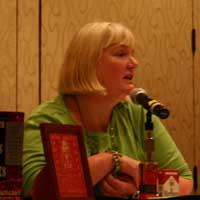
Lucy Zahray PhotoPoison is not a rare crime it’s just usually undetected. People are rarely caught on their first poisoning. When a poisoner is caught on their first victim it is usually because they got drunk and bragged, spent money like crazy, or killed five people in five days (overkill).

The topic today is the Big 3: Arsenic, Strychnine, Cyanide

Arsenic – a rock that’s mined straight from the ground. It’s the 25th most common earth element.

LD 50: 150 milligrams (NOTE: LD 50 is the dose at which 50% of the subjects will die from the dose.)
always arsenic doesn’t break down, found in cremains, found in cemeteries.

There are a lot of areas where the water or land is contaminated with arsenic. During the Civil War the dead were sent home, if the first war where the dead could be transported back to their homes. The bodies had all the parts that could spoil or hold disease removed and the cavity with arsenic. So, most cemeteries with Civil War bodies buried in them would contaminate the land and water around them.

You can find arsenic in antique stores – usually as fly paper, or any products that say something like “sure death” or have a skeleton on label. Often the products don’t say poison – just read the ingredient label.

Fly paper is good and common way to find arsenic. It’s water soluble and has no flavor or odor (slight garlic smell when cooked/hot), looks like sugar in a bowl and could be put in coffee, tea, juice. If someone was dosed in the morning they might not get sick for hours and the killer could be far away from the crime. If symptoms not recognized might not even no it was murder.

Two Methods – acute way – big dose get sick and die or the chronic way give tiny doses over time and they sicken/recover/sicken again then finally die usually seen by doctor in between and thus have a history of health problems so death is not suspicious. The trick is to give the poisoner a good motive and to make the murder interesting enough to deserve writing about it.

Many myths have developed around arsenic:
One is that taken a bit over long period of time and then get immune – what you get is dead.

Medically you can test bodies for arsenic so it could be found. They can test hair, for example. Many people live in environments with high background levels of arsenic (causes intestinal problems, rice water type diarrhea – may indicate arsenic poisoning.)

Arsenic has been used to treat refractory cases of leukemia (kills off blood cells) and used to kill off intestinal parasites.

Lots of history behind arsenic – once called inheritance powder…
First reliable test didn’t come along to 1850s Marsh Test after that it could be tested for. Previously to this test, they ground up parts of body and fed it to animal and if animal died same way then it was presumed to be poison.

Strychnine:
Again antique stores good place to buy it. It was sold until 1965 as a vitamin (chocolate coated to make it taste better). It was believed to improve your blood and wind and GI motility (constipation treatment).

Strychnine is one of the most bitter flavors (1 part in 15,000 is detectible from bitter taste) so it was chocolate coated, or licorice or espresso. Or put in something that is supposed to have a bitter taste so it would be less noticeable.

The phrase “If it tastes bad it is good for you” was basted on the strychnine taste.

LD 50: 15-30 milligrams.

Didn’t need Rx or doctor’s orders, you could just buy it.

If you spit it out because of taste you still might have enough to die or at least get very sick. It inhibits the ability of the cells to not send messages. Everything is stimulated to contract (example with fist, thumb in and pull toward body). All senses are heighted and don’t loose consciousness. Strongest muscles controls contractions so body bows (head and feet on ground, body raised up). Victim can’t breathe because diaphragm is contracted. Anything can set off next wave of contractions – still aware and more sensitive to the pain.
Becomes cyclical. Most victims die between 3rd and 5th set of contractions.

You really, really, really got to hate someone to use strychnine.

Organic compound, comes from a tree can by seeds (when extracted is tarry black substance, if further processed then white powder). Seeds are size of quarter; round fuzzy, small indent (myth says that indent is finger print of God).

Any old poisons have a lot of myths and legends associated with them.

Still used in US as predator control. Legal to buy it – no real control on sale.

It was thought for a long time that if you survived contractions (can survive if get to hospital, give huge amounts of muscle relaxation drugs, put on a vent). But now they know that the contractions cause body to heat up to 106 or 108 temperatures – in about three weeks liver, spleen, and kidneys got too hot to keep functioning. Now we know there’s a latency period and will die of complications weeks to months later. More distance between victim and poisoner the less likely of being found as the murderer — which makes for better plots and the killer being harder to find and identify in the story.

Taken off market as vitamins in 1956.
When a drug is withdrawn you can sell what you have in stock…can’t make anymore. If it is Recalled — take of shelves and send it back..
Most things are withdrawn not recalled.
Rigor mortis sets in almost immediately, and body stays in contracted state by time rigor set in it’s really just wearing off – throws off the time of death.

Cyanide:
If you want instant death – hydrogen sulfide (death on indrawn breathe)

LD 50: 2 milligrams.
Between 2 to 30 minutes to die, bitter almond smell, most people can’t smell it and most of the people who can’t smell it are men).

Death in few minutes or 3 hours depending on dose (everything depends on dose).
Generally inhaled is fastest way to kill someone
Injection is second fastest way (but harder to do)
absorbed through intact or abraded skin. (patch)

Cyanide binds up oxygen carrying cells so it’s a suffocation type of death.

Blood testing for poisons: No general test for poisons just a test for each individual poison or drug. Tests are expensive, time consuming, need to know what to test for or you won’t find it. So has to narrow down the field via symptoms or lifestyle. Test take time and often find the problem after victim is dead.

3:45 – 4:45 Mystery Shrouded in Classic Literature: The Mystery of Emma.
Panel: Jane Cleland & Peggy Ehrhart.

First, Jane Cleland went over the definition and identifying characteristics of a traditional mystery. Her talk was very interesting and filled with lots of observations and quotes. Here’s a few from my notes:

What is a traditional mystery?
Definition: work of fiction, drama, film dealing with crime.
Fair play mystery – audience knows everything as soon as the detective but it’s identifying the important from the non-important hides the clues.

Thriller – stopping the crime is the crux of the story.
Traditional mysteries – suspense is not as crucial. Try to figure out what happened.

Mystery is novel of revelation not action.
Contemporary mystery has evolved into whodunit and whydunit

Traditional mystery – character drives plot, reader must crave knowing how this person will handle that situation.
Reader engaged not by trill seeking by need to know.

Traditional and cozy are often used interchangeably.
Qualities for traditional: murder usually happens off stage, if violence occurs on stage no graphic details, murder occurs in first chapter or two, no swearing, victim and killer are known to one another, solution is from deductions of sleuth, in series secondary characters occurs. Red herrings.

Red herrings are crucial elements of trad. Mystery – false trail. A narrative element to distract reader from something else.

6 ways red herrings used:

  • overlooked detail
  • wrong interpretation of a known fact
  • casual mention in conversation
  • no reason to be significant unless you have specialized knowledge
  • absence of something that should be there
  • band wagon fallacy – when someone argues for a certain interpretation because of their own beliefs. Popularity is unrelated to its correctness.

Next Peggy Ehrhart discussed Jane Austen’s Emma as a traditional mystery but without a murder. It’s a mystery that rather than solve a murder tries to determine who loves who. P.D. James said that if Austen was writing today she’d be one of our greatest mystery writers.

Emma is blind to obvious clues. Mr. Knightly is far more observant. Shown best by the fact that Emma doesn’t recognize Mr. Elton true characters when she tries to match him with Harriet Smith.
Three examples of Emma’s blindness: painting of Harriet, the riddle delivered to Emma not Harriet, and the party that Harriet misses.

Second misunderstood plot element: Frank Churchill and Jane Fairfax (secret engagement).

If Austen wrote mysteries they would be fair play ones since all the clues are there. Frank always promises to pay a visit to his father but only actually comes when Jane is visiting her relatives. Austen disguises this fact so that reader misses as does Emma. Jane plays piano and Frank is off to London for haircut and suddenly Jane gets a piano delivered. (to hide his involvement with Jane he grabs onto Emma’s notion that Jane must have an admirer and runs with it, setting Emma on the notion that Mr. Dickson is the man).

Clue hidden in plain sight: Mrs. Bates very talkative. At ball, Frank helps Jane on with her wrap which shows his interest but his clue is buried in the tons of other information that Mrs. Bates talks on and on about.

Mr. Knightly brings up the fact that he believes Frank and Jane are a couple and gets pooh-poohed by Emma.

Frank’s letter in Chapter 14 after Mrs. Churchill’s death is much like the final reveal in a traditional mystery.

In many of Austen’s works you end it and then it’s the realization that you should have seen this because all the clues are there.

Opening Ceremonies: Announce the Guest of Honor, the nominee for the various awards and welcome every one to the convention. This was followed by a reception.

7:30 – 8:20 pm: Humor Panel
Panel: Elaine Viets (moderator), Don Bruns, Pari Noskin Taichert, Parnell Hall, and Jeff Cohen.

There was lots of joking around and some serious discussion of humor in mysteries. The most important point that was made was that:
The humor has to come from your character not from you.
If you try too hard it will fail.
If you think what you wrote is hilarious, wonderful humor — it probably isn’t.

This was followed by the auction but we had to leave at this point. We’ll be back tomorrow to cover the full day of programming.

Yikes, the end of the month is approaching…

Posted in Conventions, THE Zines, Writing on April 29th, 2009

I feel like Chicken Little with the end of the month approaching. The zines go live on May 1st so I’m up to my eyeballs in proofing and writing. Have to get everything done by Thursday because on Friday, I’ll be a Malice Domestic (if you’re there track me down and say howdy!).

I took some photos of what blooming in the garden but haven’t had the time to post them.

Great day for yard work…

Posted in Hearth and Home on April 26th, 2009

April and the Azaleas in bud

Well, today was a beautiful day.  Since we got most of our shopping and errands done yesterday, we were free to work on home projects.  So once I caught up on email and entered the books it was out to the yard to clean up.  We managed in half-hour bouts to get most of the leaves off the ground by the side of the house and along the retaining wall of the side yard.  We pulled a lot of weeds too.

We also managed to pull a lot of poison ivy plants from an area about eight feet by ten feet.  Before we did that, I had to pull on my elbow length gardening gloves.  After that bit of weeding it was into the house change, shower with Burt’s Bees Farmer’s Friend Poison Ivy Bar Soap.   I had three or four rounds of poison ivy last year and I’m hoping to keep on top of it this year — not get it and manage to clear more of our land from the vile stuff.  It’s been moving closer and closer to the cleared area of the side yard, orchard, and house.  We need to get it back from where we spend our time.

We managed to get quite a bit done before I was to sore and tired.  Hubby tries to keep me down to half-hour work limits so I don’t overdue.  I’m always let’s just do this one more bit and then the next day I can’t get out of bed or move.  So, he’s right.  I’ve been doing much better but the short periods of hard labor and then resting are much easier to take.  Even though he tends to do more.

Today it was in the 90’s and so far we managed not to turn on the air conditioning.  We did turn on the fans in the living room though to mix the air.  It was great.  But now it’s thundering out and I think I hear the pitter-pat of rain on the windows.  So we may not get to finish the side yard tomorrow if the leaves are all wet.

Voting for the Hugo Awards — or why don’t eligible voters vote

Posted in Convention -- World Science Fiction, Politics, Rants, Reading on April 25th, 2009

Hugo Award that will be given during Anticipation 2009As many of you know, I’m a fan of science fiction and fantasy among other forms of entertainment and enjoyment.  Usually, hubby and I attend the World Science Fiction Convention which this year will be held in Montreal and is called (this year) Anticipation.  Members of the convention get to nominate and vote for the Hugo Awards which are given out at a ceremony held at the convention.  A friend pointed me to this great article on voting for the Hugo Awards. Kate Heartfield has raised many of the issues that have niggled at me for a long time.

We attend Worldcon every year that we can manage it. We attended our first as our honeymoon — we’d gotten married the weekend before the convention. Ever since, we celebrate our anniversary by attending the world science fiction convention and we’ve only missed three since that first one. We’ll be missing Anticipation this due to a variety of events including the current economic situation in the US. This year, because we were attending members of the last convention, we did nominate for the Hugo awards but we’ll be ineligible to vote for them.

Each year it has been a bit of work to figure out what to nominate (it has to have been published or first presented during the previous year), and once the nominees are announced to gather all the works and view and/or read them. But we, as do many others, take this privilege seriously. Hugo awards are presented to the best work of the previous year. The list of winners is impressive and many of the books, stories, and media that has won has withstood the test of time and is still remembered and read by fans of the genre.

Yet, each year when the numbers are published it seems that only about five hundred people (plus or minus a couple of hundred depending on the category) take the time and effort to nominate and vote for these awards. When the convention is in the US, membership (those attending is in the thousands (4-6,000) when the convention is outside the country the numbers are fewer but still many buy supporting memberships in order to nominate or attending in order to vote (whether they attend or not). Yet the numbers who actually nominate and vote remain fairly constant.

[NOTE: I’m not bothering to look up the actual numbers. These numbers are out there in the internet but I’m going from my memory and impressions and I’m fairly sure I’m only off on specifics and it’s the generalities that I’m talking about.]

When we first started attending the conventions, we had to go out and find all the nominated works and read them and then vote. One rule we’ve had is if you don’t read/watch it you don’t vote in that category. These awards are for the best and if you don’t know that category and haven’t read in it or haven’t read anything published in the appropriate year then you can’t make an informed decision.

Over the last several years, publishers and authors have been making the works available to members of the convention so that they can read all the nominated works for free. Of course finding and viewing the nominated works in the media categories is a bit trickier but the advent of Hulu, NetFlix and other sites have made this easier also.

So, why don’t the members who are eligible nominate or vote? I don’t know. For the last several years, I’ve been asking and some of the reasons I’ve been given are:

  • I don’t have time
  • My vote won’t count, it’s sewn up before we even get to nominate/vote
  • I’m not an expert on the field, I just read it for fun
  • No one cares what I think
  • I don’t read any of the people who get nominated (follow-up question: did you nominate the ones you do read — answers is usually, No, why bother)
  • Why bother, the best stuff never wins (follow-up question: did you nominate or vote — answer, No)

In point of fact, these answers are pretty similar to why people, in the US at least, don’t vote in their political elections. What I can’t understand is how you can expect that your choices would ever win if you don’t bother to get out there and nominate (too late for this year) and vote. I get truly baffled by the people who say “my opinions/wishes/vote doesn’t count” and then a follow up shows that these same people don’t nominate or vote or let their opinions/wishes be known. Seems to me if you sit and do nothing, you can’t expect to have your opinion/wishes taken into account.

Many years none of my nominees make the ballot. Many years people on the ballot are ones that I’ve never read before — and who have later become favorite authors. By taking part in the process, I’ve found authors I might not have found otherwise. I’ve at least done my part to see that the best in the field gets a fair chance at the spotlight.

So, why do so few chose to exercise their option to make a difference and to celebrate the best in the field?

The Power of Positive Thinking or is it….

Posted in CSA on April 23rd, 2009

The Power of Positive ThinkingI’m not sure how we got on the topic but, while trapped in the car for some long driving as we ran errands today, Hyperion and I got to talking about positive thinking sort of as an off-shoot of wishful thinking being related to quantum physics (which is for another post).  Anyway, in kicking this topic around I began to crystallize some of my thoughts on it.

Most people have heard of Dr. Norman Vincent Peale’s book The Power of Positive Thinking. The basic premise is that if you feel good about yourself, good things will happen to you or come to you. This is also the basis behind The Secret by Rhoda Byrne where your positive thoughts are like magnets that cause good things to come to you. It’s also the basis for many of the books that instruct how to use your mind to concentrate on what you want and to have what you want come true.

But what I think is that by putting yourself into that place where you are concentrating on what you want, you begin to change yourself and your attitudes. From listening to some of the people who have read these books and dedicated themselves to following the various steps, there seem to be two types of outcomes. One is nothing much happens because they wish or think positively about what they want, but then they don’t do anything but wish or think.

However, the other group not only thinks positively, but they also begin to act in ways that cause the “good” thing/event to happen to them. They take a class in adult education, local technical school, junior college, or evening college courses, or go to the library and study up on what they’re hoping to gain — which is usually, better pay, a vacation, a promotion, or whatever. It’s the activities they are performing to aid them in gaining their goal that helps to change their attitude and gain them the abilities (concrete skills) that eventually gain them their positive outcome. It’s not just the positive thoughts beamed out in the universe; it’s the positive thoughts that are beamed inward that encourage the person to take their future into their own hands and make it better.

People don’t work in a vacuum.  They are worked upon by those around them. If others don’t think much of a person, that person internalizes that and acts accordingly, believing they aren’t worth much. If the other inflates a person’s ego, they also have problems when their expectations and their skills don’t match. However, if by focusing on a goal and then working to actually bring expectation and skills into alignment, their goals are often achieved. Usually not in the manner expected, but in a manner that, in retrospect, actually is what was wanted or needed.

On the other hand, people who simply sit and wish the good to come to them and never do anything to gain that change in their lives are bound to be disappointed and always looking for the next book that might have the key that actually will work for them — as long as they don’t actually have to do more than think about it.

My grandmother used to say, “If wishes were horses even beggars could ride.” This was usually whenever, I complained about wanting something but wasn’t actually planning to do any of the work to earn it. Yes, you need positive thinking but you also need good old fashioned work to reach the goals you set for yourself.

What’s your take on this?

Hyperion AvatarHyperion here:  I freely admit to being a total muggle; sometimes even Gayle despairs at my total disdain for the other-worldly.  For all the above post, there’s a fair bit of romance in her soul.  She may not depend on the magic to do job by itself, but that doesn’t necessarily mean there’s none out there.  She still has hope.   But, as for me?  “There’s no such thing as magic!”  That’s just the way I’m wired.   Well, there is one exception.  I think Gayle is pretty magical … but then I’m a bit biased, and the matter is not open to scientific inquiry.